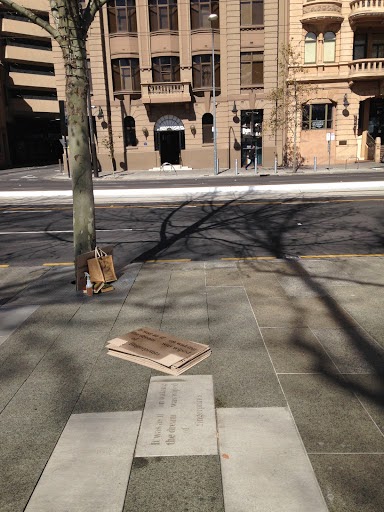
I love this project from Raining Poetry in Adelaide, where they have stencilled very short poems on the pavement with a special paint that only shows up when it rains.
My own rain poem is in this photo.
According to the little map which you can find here – so you can walk around on a rainy day and read them all — my poem is on the North Terrace, in between King William and Kintore Avenue.
(If you happen to see it one day, please take a photo and send it to me and I’ll post it here. Thanks!)
The project is organised by University of Adelaide PhD students Camille Roulière and Marianne Braux, who were inspired by a similar project in Boston.
This year they received more than 120 submissions and chose 29 to grace the streets of Adelaide. The poems are painted onto the pavements using stencils and a special kind of paint so that the words only show up when it rains.
Fabulous idea! The paint is expected to last about six weeks (from early September 2018), so next time it rains, grab your umbrella and go on a poetry walk.
This essay/talk explores some of the issues I encountered with the publication of my fiction bookHow to Conceive of a Girl (Vintage/Random House, 1996) regarding how and when (and if) to seek permission to use short quotes from a wide range of pop culture and academic sources, given that my use of these snippets was creative and designed to engage critically with the cultural environment inhabited by my characters and stories.
It was originally written as a presentation at the National Book Council summit, Authors, Authenticity and Appropriation in Melbourne, September 1996 as ‘I’d Like to Have Permission to Be Postmodern But I Don’t Know Who to Ask…’. It was subsequently published in the Sydney Morning Herald as ‘Steal this book’ (22 March 1997) , performed at Bundoora Literary Festival (1997), broadcast on Books and Writing on ABC-RN (23 May 1997), published online in Jacket Magazine in October 1997, and reprinted in README! ascii culture and the revenge of knowledge(UK: Autonomedia/Nettime Publications, 1998).
A printable pdf from the SMH version and an audio only version is available below (or audio via youtube here).
*
This is my story, and I’m sticking to it.
Well, anyway, it’s stuck to me now.
It all began – or my part in this story began – when my editor wrote a note on my manuscript saying: ‘You’ll have to get permission for all these quotes.’ Although I suppose it really began when I naively wrote the book with all these quotes in the first place. Or maybe it began that day, back just before I was born, when my father walked into the house carrying a brand new television.
Of course, in some people’s reckoning, it began when America dropped the bomb on Hiroshima…
Anyway, I’m part of a certain kind of world, and I write in a certain kind of way; a way, in fact, that has taken me about twelve years to develop. I used to write stories, and essays; and now I write stories that also sometimes function as cultural criticism, history and review.
As such, my book How To Conceive of a Girl (Vintage, 1996) incorporates lots of little narratives – outside texts – within its wider narratives. Everything from all the stories and anecdotes people have ever told me, to bits from ‘The Donahue Show’, the Bible, In Bed With Madonna, books on infertility and birth, lines from popular songs, gossip items from New Idea, fragments from philosophy texts, tourist information, characters from detective novels, excerpts from 1960s school text books, and so on.
I’m definitely a magpie, but I have a taste generally for things that are well-worn; often things that are of no use any more, or so common that no one’s really going to miss out if I make use of them too. The cast-offs or the mass-produced – all the things floating or left lying around out there. The space junk. Mostly things produced originally for an entirely different purpose. In general I don’t pick my bits up out of someone else’s nest, I pick them up off the street, or in supermarkets, or I dig around in rubbish dumps.
I’m really not sure how exactly I came to be suddenly convinced that I had to get permission for all these things or I was going to be sued… I guess I was isolated at the time, I was going through some other legal problems (and hence having to face ‘reality’ – in which good intentions and ethics are largely irrelevant), and I tended to get conservative advice the first time around.
There are so many rumours out there; it’s such a ‘grey’ area of the law. I also knew that my own publisher had been sued last year, that it had cost them probably more than I’ll ever make from this book, and that just generally everyone was clamping down all of a sudden on this kind of thing and becoming very serious about it.
So, there I am: ten hours a day on the phone, drafting letters and searching back through boxes of notes. Doing (what I now see as) crazy things like making about twenty phone calls trying to track down someone who might know where the records of the now defunct Sunday Observer are held so I can get the name of the journalist (no byline, so probably from the US) who wrote a piece on Lynda Carter back in 1980… (A piece which some wonderful sub-editor headed ‘I Want a Baby! – Confessions of Wonderwoman’. So perfect. How can I presume to ‘make these things up’ when they’re so already out there?)
Then I’d used twenty-five words from an Agatha Christie novel – only twenty-five words, but it’s Hercule Poirot and one of his memorable pronouncements on facts and slips… And forty-three words from a philosophy text – but do you need to get permission from the original author, the translator, or the journal in which it was published (or all three?).
Then there’s that story within the story that I’ve rewritten from memory from a 1960s Reader’s Digest Omnibus which turns out to be an abridgment of a children’s book by James Thurber… And just tracking down who holds the rights for a particular song can cost me $50 per song if I go through AMCOSS[i], so I join a Lou Reed mailing-list on the internet to see if anyone out there knows and can tell me for free, and I get dozens of daily emails from fans all across North America listing every song in the order he sung them for every concert on his tour, and learn to refer to him as ‘Lou’ or ‘The Man’ like everyone else, and eventually after a few wild goose chases I find out that ‘Pale Blue Eyes’ is administered by EMI.
(Um… It was EMI that sued my publisher.)
You see, all this time while I’m busily scratching around after these motes, I guess what I’m desperately trying to ignore are a few rather large and uncomfortable logs.
The first one is this: I’ve made seven references to particular recordings of songs in my book – albeit brief, some only a few words, but ask any music publishing company and they will act totally horrified and aghast at the idea that you could use any word or phrase from a song without permission. Permission fees for songs are determined by the company, but a fee of $150-$250 is standard. Add that up, and these seven tiny references (and oh how merrily I knitted them in, in the first place) could end up as a bill for perhaps thousands of dollars…
And then the very nice young woman from Marie Claire in England (‘Oh your book sounds absolutely wonderful!’): once I explain (on an expensive telephone call late at night) that from the article syndicated to Cosmopolitan four years ago, I’m only using about eighty words that aren’t actually on the public record, she says, ‘Oh, in that case it will just be a token fee of fifty pounds.’
I see.
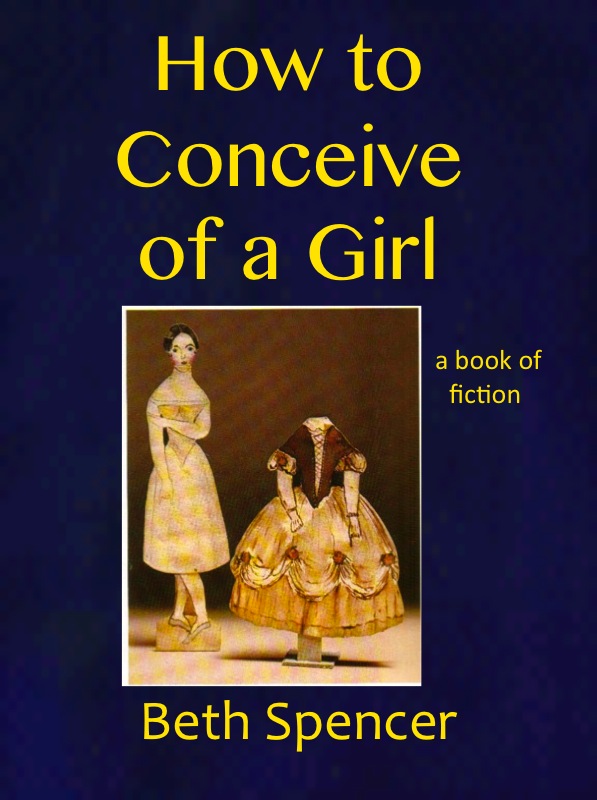
Cover art by Linda Dement for How To Conceive of a Girl, 1996
And so (fortunately) it’s around about this time that I pause before I post out my two dozen letters seeking permissions…
What if even a proportion of these want to charge ‘token fees’?
The fact is, you don’t earn much money from literary fiction in Australia – especially a book of experimental stories and novellas by an unknown author.
Fees like this would not only put me in debt for the next few years, they would make it virtually impossible for me to keep doing what I do. In a very real way they threaten my next book, which I’ve already spent a year and a half researching, and they threaten everything I’ve spent twelve years learning how to do.
So there was this minor practical problem I had to deal with.
And then the other log that I could see (in my fitful nightmare-filled sleep, especially if I had to set the alarm to ring Lou in New York at some ungodly hour) – sweeping down the river towards me… Well, there were two of them, sort of tied together. And sitting up there on the first, with an expression on his face that I couldn’t quite make out, was the ghost of J.M. Barrie.
In a novella which is about a third of the book, I’ve used the occasional brief quote from Peter Pan as a structuring principle – typographical stepping stones or punctuation points, if you like. Except that my Peta is a girl; which means that even when the quotes stay the same, with a girl-Peta and in the context of a story exploring being childless (either by choice or otherwise) and cultural notions of femininity and adulthood, they take on quite different meanings from the original. For instance:
‘If you find yourselves mothers,’ Peta said darkly, ‘I hope you will like it.’ The awful cynicism of this made an uncomfortable impression, and most of them began to look rather doubtful.
And there are other times where I’ve strategically mis-quoted.
Every time a woman says ‘I don’t believe in babies’ there’s a baby somewhere who falls down dead.
The quotes are something like less than four hundred words out of twenty thousand; and I actually feel that Mr Barrie himself would approve, but he’s dead and it would be some unknown person who administers the estate making the decision. What if they, just personally, didn’t happen to like what I was doing?
If they refused (and a copyright holder is not required to give any reason for a refusal), there goes a third of my book, and a year’s work.
And on the other log: a whole heap of people from Fatal Attraction, barrelling down on me for a story in which I’ve not just quoted bits of dialogue from the film, but have also appropriated the main characters and actors and sent them off on a mission around the back streets of Newtown in Sydney…
But how can I possibly ask James Dearden and Adrian Lyne for permission to critique their film in the way I have in this story? (It’s not exactly a flattering view.)
So: it was at around about this point that some of the people I was seeking advice from (such as the Australian Society of Authors – who did prove to be very helpful in the end), began to accept that maybe I wasn’t just a criminal-minded anarchist post-modernist who wanted to be able to rip off other people’s words without paying for them… That maybe my rights as a writer also needed defending. And that this (like most things in life) isn’t just a simple black and white copyright issue, but is also about things like free speech.
I can’t keep writing this way if I have to pay everybody a tithe. (And I’m not just talking about lots of little sums: Macmillan in the UK wanted $500 for every print run for a few brief quotes and paraphrases from a 1970s book about faeries; and EMI originally asked for $830 for eleven words from ‘Pale Blue Eyes’).
It’s a bit like when someone tells you an anecdote and you say, ‘Hm, can I use that in my next book?’ and they say, ‘Do I get a royalty?’
It just can’t work that way – if I paid everyone who’s ever contributed something to my work, they’d all end up getting about half a cent each and I’d end up with nothing to pay my rent with and the added burden of knowing that every word I write might end up costing me more money than it’s ever likely to make for me.
And I can’t keep writing this way if anyone who doesn’t like what I’ve said or implied about their work gets the right to refuse to allow me to refer to and quote from it.
The simple answer is: well that’s what the fair usage clause is there for. (This is the clause within the Copyright Act that allows for ‘fair usage’ of another’s work for the purposes of research, criticism or review.)
But for one thing, this is a book of fiction. Can I really rely on getting a judge who understands that fiction can sometimes also be criticism?
And for another: most of these things aren’t decided by judges anyway, because they never get to court.
Music publishing companies realised this a long time ago: that it’s whoever has the biggest team of lawyers and the most money to throw about who in effect get to set the laws. For a long time their interpretation – that even using one line of a song constitutes a copyright violation – has been accepted as fact. Even though to my knowledge this has never been tested in the courts; and it’s certainly not the advice I received from the Australian Copyright Council.
In other words, if publishers settle out of court – and who can blame them? – it becomes irrelevant whether my use is legal or not. (And it’s certainly irrelevant whether it’s ethical or not.)
Let me say, here and right now, that I fundamentally support the principle of copyright protection for authors:that is, the principle of asking for permission to reproduce substantial pieces of another’s work, and the need to compensate artists for any loss of sales this might involve, or for their original labour in producing the work. (Effectively: so they can go on producing more work).
But I also believe in the principle of free speech, and the need for writers to be able to imaginatively, creatively and productively engage with the cultural products and contemporary cultural events around them. I can’t see that it’s in anyone’s interest (least of all other artists’ and musicians’) for us to be forced to go on writing books as if music, television, films and magazines don’t exist or have important effects in the world or on people’s lives and feelings.
And given the nature of contemporary culture, I really don’t think it’s useful to make a distinction between those who appropriate and those who don’t. Everyone borrows from everyone; everything is connected to everything else. What I think is much more useful is to look at the effects and implications of the myriad different kinds of borrowings that do go on: the ethics, if you like, of each type of borrowing, and the politics.
For my own part: I don’t just tack other people’s work onto my own in order to enhance or embellish it (if I did, then it would be a much simpler proposition to just remove it and save myself time, money and trouble). I’m meticulous about referencing and acknowledging other peoples’ work in my own – my initial training was as an historian, and I see no point in putting the quotes in if readers aren’t aware of where they come from or aren’t given a sense of their original context. Especially if what I’m trying to do is to critique, disrupt, extend or play with something, then it’s essential that the original intention (or effects) be also made clear at the same time.
So these are my own personal ethics (or politics) about what I do.
Thus the problem for me, for instance, with Helen Darville’s[ii] appropriations was not that she used someone else’s words (I think pastiche as a form is fine; it can be effective and interesting if done well) but that she didn’t acknowledge this. If she had, of course, then her own lack of personal experience and, hence, personal authority would have also automatically been acknowledged and made obvious, and this would have altered the whole way the book was experienced and read[iii]. It would have been a different book, with a different history (and vice versa).
Well, anyway, while Darville’s lawyers may be able to sleep soundly with the conviction that her appropriations (while admittedly ‘bad form’) are not actionable (that is, not a clear violation of the Copyright Act), I’m afraid I still have the occasional watery nightmare. (Especially with the new Moral Rights law ready to be introduced into Australian Federal Parliament at the next session… but that’s a whole other kettle of worms.)
In fact, sometimes I wonder if it’s not the case that the more ethical I am, the more potentially actionable I might be making myself in the long run.
There were more than a few times, when talking about these issues, in which I’d receive the helpful advice: well, just don’t acknowledge it. Don’t identify the source and no one will notice, or they’ll have a harder time proving it. Just shuffle the words around a bit and leave off the author’s name. Whatever you do, don’t write and let them know!
In other words: steal it.
And I guess this is my concern: that if we have an inflexible attitude to the use of other people’s words, then we are encouraging a climate in which people steal rather than borrow, pilfer rather than critique. Or where the jokes become merely private.
There seems to be this idea out there that appropriation is easy. A bit like the old idea that free verse in poetry is easy – if you don’t have to rhyme, then hey, where’s the talent in that? Anyone can be a poet (well yes, I guess, in a sense, that’s the point)…
But if you are concerned with attribution and sourcing and referencing; with evoking the original context and maintaining the integrity of the fragment even in its new context; with all these ethical and political issues, as well as trying to sew the whole thing together into a compelling narrative; with preserving a multiplicity of original voices, and yet still taking some kind of final authorial responsibility for what you are doing; it’s actually quite complex and takes a lot of thought, and a lot of repetitive, painstaking labour, and imagination.
It’s just not as easy as it looks.
I prefer to think of myself as a collaborator or cultural partner, not a thief.
In fact, without exception (including The Man himself, who instructed EMI to drop the fee to $130AUD after I wrote him a letter raising these kinds of concerns), [iv] every author I’ve been able to directly contact has been delighted that I’ve used their work and has wished me every success.
After all, lifting something can be exactly that; it doesn’t have to be exploitative.
Or as Eudora Welty [v] once put it: ‘Criticism can be an art, too. It can pick up a story and waltz with it.’
*
Audio only version — (from the CD Body of Words, Beth Spencer, Dogmedia, 2004)
For SMH article to print – Beth Spencer-Steal this Book
(If you are using this as teaching material, could you please link to this post but also print this version and/or note it in your photocopying records with CAL (Copyright Agency Limited). This way I might get some payment from CAL. Thank you for supporting local writers!)
—————————–
Endnotes:
1. Australian Mechanical Copyright Owners Society.
2. Helen Darville being of course the young Australian writer who won the Vogel Award in 1994 with a novel called The Hand That Signed the Paper, written under the name (and persona) of Helen Demidenko, and supposedly based around historical research and oral histories from her Ukranian family. The book won the Miles Franklin Award in 1995 which sparked off intense debate about whether or not the novel, which dealt with Ukranian history from the 1920s through to the Holocaust, was anti-semitic and/or worthy of such an award. During this debate it was also revealed that Helen Demidenko was actually Helen Darville, whose parents were British migrants, not Ukranian. Further allegations of plagiarism also surfaced, as several passages in the novel were found to be modified versions of passages from other novels and books. Debate wasn’t just confined to those interested in literary matters (or to those who had read the book), but became hot news in the mainstream media for over a year and several books were published on the topic. Two years later [1997] the Darville/Demidenko Affair still rates chapters in books about Australian ‘culture wars’, such as Mark Davis’s Gangland and McKenzie Wark’s The Virtual Republic (both published by Allen & Unwin, 1997).
3. Which is to say that you can’t argue with someone saying ‘I feel’ or ‘I felt’ or ’this is how I (or my oral history source) experienced it’; but you can argue with someone saying ‘this is how I think they would have felt’, or ‘this is how I imagine they would have experienced it’.
[iv] [footnote added 2004] However that permission was only for the original Random House edition. When I sought a new licence to use it for this cd-rom and any future publications of the story ‘A Lover of Space’, the fee set was $1000. I decided to change the text of my story, and paraphrase the lyric in such a way that it could no longer be regarded as a copyright issue, even by the most litigious. I don’t think the change injures my story, however a paraphrasing can in no way do justice to Reed’s original lyric, and the two-way effect (of the story as a piece of criticism and review that works back onto the lyric) is pretty much lost. Which is to say that I’m not sure from what exactly this particular interpretation of the law is ‘protecting’ songwriters.
[v] Eudora Welty, from ‘How I Write’, Virginia Quarterly Review, Spring, 1955.
[Also at my mother’s funeral in September I sang Danny Boy for her. Here’s my introduction to the song.] [If you’d like to read part 1, the eulogy, it’s here.]
Mum loved music.
When we moved to Yarra Glen Dad told her she could have the money from any twin calves. I guess he assumed this would be a rare occurrence. But for some reason there was a whole spate of twin calves after this, and one of the things she bought with it was a record player. Back then it was out in the back boys bedroom, but when we moved to Croydon it went in the dining room and on Sundays there would always be a record playing while the dinner was getting ready. The Seekers, The Sound of Music, Johnny Cash and Jim Reeves.
When she moved into Wantirna Village I bought her a CD player. After that her house was always filled with music, and when she moved to Elly Kay for a long time too until she lost the ability to work out how to use it, and eventually to even recognise it.
Some of you may have read the post I wrote on FB about the last few days of her life. I live on the central coast of NSW, and I don’t travel too well, and when we were told she was failing I was in a state about whether to pack and fly down straight away or if it was better to wait a bit, so I could prepare for what might be a long haul.
[btw.. just want to say how grateful I am to Noel and Jan, for all their love and care of Mum both at Wantirna and at Elly Kay. They were always there for her. Thank you Noel, and thank you Jan. ]
So, feeling a very long long way away…
I made a little shrine with a candle, and that lovely photo of her as a child sitting in a wicker chair some of you may have seen, and this necklace.
I kept the candle lit the day they started palliative care and I when I passed by it I would talk out loud to her and sing songs. And tried to work out what to do.
The following morning I woke up at 4.30am, and for quite a while I was singing to her (Danny Boy, The Lord is My Shepherd, Amazing Grace), talking to her, imagining all of us in the room with her and holding her, telling her that her brothers were all here, and her mother and even her father she hasn’t seen since she was six, and my father – that they were all here for her. I lay in bed talking aloud, thanking her, crying and talking over memories, and telling her she had our permission to go, that we were all grown up now and will be ok.
And it was beautiful and peaceful, and I felt very connected to her.
Eventually, some time after five, I went back to sleep and was woken a few hours later by a phone call saying that she had died at around 5am.
The power of music.
I wish Iris and Jess were well enough to sing to you today because they have amazing voices.
I’m very new to singing. I joined a choir about 18months ago and I have become a singing convert.
So for Mum’s 95th birthday last year the family were gathering, and I suggested we sing a few songs to her. By that stage she had no conversation anymore, she hardly had any words. On the vast majority of days she said nothing at all.
I printed out some song lyrics and even those brothers who said they would just mouth the words or sing very softly got right into as soon as began singing Vera Lyn’s wonderful World War 2 classic, ‘We’ll Meet Again.’
Who can resist singing? Especially a song that is practically in our DNA.
I’d also asked Brian to choose a hymn,and he chose ‘What a Friend we Have in Jesus’, which was a great choice because it turns out that was one of the hymns she had written down that she wanted us to sing today.
So I sat next to her and held her hand and while the others sang around us I sang the words of ‘What a friend we have in Jesus’ right close to her ear,and when we finished she looked at me – really looked at me with a kind of wonder – and I said, ‘You remember that song, don’t you’ and she said ‘Yes I do.’
Later while the others were talking, I moved in close and sang ‘Danny Boy’ to her, and again she leaned her ear right towards me and really listened, and at the end of it she turned to me said, ‘That was lovely.’
And I reckon if the last words your mother ever says to you are, ‘that was lovely’, well, I don’t think that’s too bad.
So this is for you Mum.
(Sorry it’s not such a great version, but just wanted to add it her for her.)
For the first part of my eulogy at her funeral and a slideshow about her life, go here.
 My own rain poem is in this photo.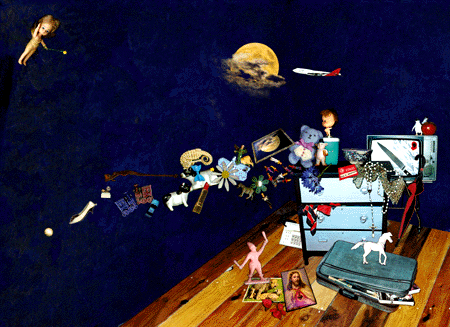
 (from the CD Body of Words, Beth Spencer, Dogmedia, 2004)
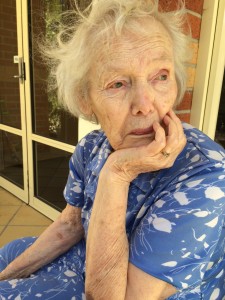 Mum loved music.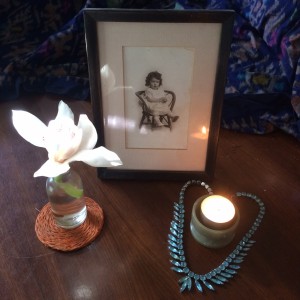
![[The Party of Life, cover]](http://bethspencer.com/blog/wp-content/uploads/2012/11/sm-edged-front-cover-Party-of-life-227x300.jpg)